Page 1 of 1

Description

Posted: Sun Jul 16, 2023 3:40 am
by Flession
Image

The Guildhall and Market Wards mean business: nonstop, round-the-clock trade conducted by the multiverse’s premiere merchants, craftsmen and jink jugglers. Sandwiched between The Lady’s Ward and the Clerk’s Ward, this is Sigil’s most cosmopolitan area – if it walks, crawls, or flies, and has jink to spend, it’s welcome here. The Market Ward is where a basher comes to find goods of all kinds: food, medicine, clothing, tools, and weapons. The Guildhall Ward is where a body comes to find bloods who sell services. Here you’ll find anyone who sells a service, no matter how exotic or odd – from a team of professional dice players to mountaineers ready to guide you through an expedition to Mount Celestia.

The differences between the Guildhall Ward and the Market Ward are incidental. The reason the two are described here is that – moreso than any other ward in Sigil – it’s impossible to tell where the Guildhall Ward ends and the Market Ward begins. The Guildhall Ward has a few more Ciphers, the Market Ward a few more Indeps. The Guildhall Ward is more residential, the Market Ward more commercial. For convenience, residents consider Duskgate Road an informal boundary; those living on one side are Guildhallers, those on the other are Marketers. The differentiation is far more historic than actual: before the Great Upheaval, the Guildhall Ward was the home of most of the former Guilds. Now, services and trade goods are sold side by side, so the borders are considered fluid.

Because of the chaotic nature of the Market and Guildhall wards, it is inconvenient to simply state the populations and list of districts, as with all the others. Players may consider every neighborhood in the two Wards to be either Market districts or Guild districts, depending on the surrounding buildings. Additionally, the players are able to find any kind of Trade or Service in this Ward with only minimal fuss – 1d4 hours of searching or a Persuasion DC 10 check to cut down the time to 1d4 minutes (but cost the berk 1d4 coppers for directions).

For your convenience, however, a brief listings of the other Districts outside of the two main ones will be listed below. If you wish to do a scene in these districts, be sure to list it in the subject of your threads:

The Forest:
Along Ritman Street, also termed Long Lane by some touts, lays a small conclave of elves, the one elven racial conclave within the city. The same touts have come to jokingly refer to the squat as the “Forest”. The community remains small, largely because most elves can’t stand the air and odd nature of the city’s geography. Little exists to distinguish the area from the other neighborhoods of the city, save the population of elves, though in the recent years they have taken to planting, without much success, a large number of trees to surround the area.

Potential Locations:
Rechvad's Persona Lavisicum: A place where customers can go to temporarily alter their personality in any way they can choose.

Ghundarhavel:
Yet another of Sigil’s racial enclaves is Ghundarhavel, the bariaur term for “home without grass”. The area and its residents are remarkably cool to non-bariaur, and in response to their less than welcoming attitude, the area has gained a second name from the ward’s touts: “Hoof Park”. The area has little draw for those of other races, since most of the shops and inns cater to the tastes specifically of their bariaur clients, and thus the food, spirits and even clothing offered is either unpalatable or unfeasible for others.

Curly-Top:
This squat of halflings in the Guildhall Ward, run by the Cipher halfling Talun Underfoot, surrounds an artificial burrow at its center. The burrow, built by Talun himself within several tons of soil imported from some Prime world, serves as a nostalgic draw to the local halflings. The area is known for its wide variety of restaurants including a nearby kip known as the Cutter’s Vineyard. The name for the restaurant comes from a clever play upon words; the inn sits as the center building within a cluster of vacant and razorvine choked kips. Diners eat upon the terraced roof overlooking the expanse of Curly-Top, surrounded by the wild growing, as well as pruned and trimmed razorvine along the actual terraces of the Vineyard itself.

Potential Locations:
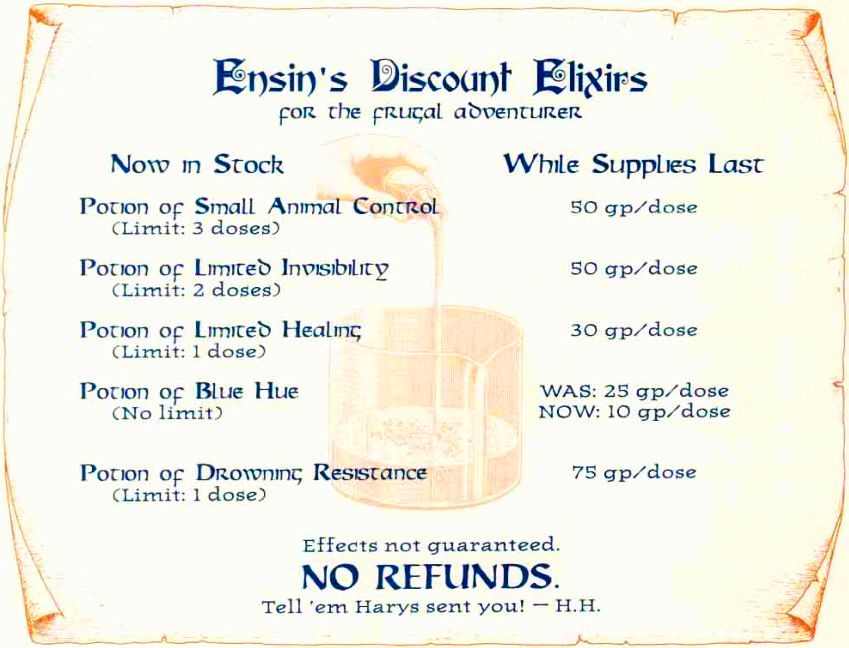
Ensin's Discount Elixers: A potion shop run by the wizard Ensin who cuts corners to produce cheap, weak potions in mass quantities.
Git’Riban / Githariban:

The githyanki squat of Git’Riban, or Githariban, sits sheltered away within the Guildhall Ward. Most of the residents keep to themselves, and even when venturing out they tend to travel in self-segregated groups. This exaggerated cloistering of the githyanki of the district is likely due to the relative proximity of the githzerai squat of Darkwell Court, or even rumors that the entire community consists of rogue githyanki from the Astral in dereliction of their duties or having forsworn the Lich-Queen.

Guilds in the Guildhall Ward

Posted: Sun Jul 16, 2023 4:03 am
by Flession
The Guildhall Ward isn't what it once was. What caused the guilds' decline? Simple. They lacked the factions' support. According to the factions, craft guilds fostered divided loyalties; bashers preoccupied with guild business couldn't devote themselves to their factions. Under pressure from the factions, the guilds gradually lost their autonomy. Some relocated, some went underground, many just withered away.

The Guildhall Ward still has a fair number of guilds, but only a handful wield any significant influence. Most concern themselves with monitoring prices and wages, discussing trends, and finding work for their members. Some offer training seminars. A few provide modest pensions for old-timers. All of them charge annual membership dues, part of which pays the rent on their headquarters, often a warehouse basement or the top floor of a tenement. Each has a symbol, worn by members as identification, and a contact person, who serves as a liaison with the public. Here's a sampling:
  • THE COUNCIL OF INNKEEPERS. This group establishes wages (for waiters, cooks, and other personnel), negotiates prices with wholesalers, and shares information about knights of the cross-trade, brawlers, and chronic bubbers. As a professional courtesy, members're allowed to stay at each other's inns at no charge. Monthly dues: 1 gp. Symbol: Crimson waist sash edged with golden lace. Contact: Bryn Ohme
  • BUILDERS' FELLOWSHIP. With more than 300 carpenters, roofers, and stonecutters, this is arguably the ward's largest guild. The Fellowship works closely with the city to secure construction and maintenance contracts for public buildings. Monthly dues: 3 gp. Symbol: Three copper bands, worn on the left wrist. Contact: Ustisha Cambris
  • ESCORT GUILD.This organization of able, trustworthy touts focuses on training and education. (The guild requires members to memorize all the major streets in Sigil.) Members are kept informed of obstacles dead giant blocking Bellwhistle Lane)
    and optimum routes (Avoid Deadfinger Way; too many muggers). Monthly dues: 1 sp. Symbol: Three concentric blue circles tattooed on the forehead. Contact: Geena Mirrathar.
  • GUILD OF TEAMSTERS. This guild numbers among its membership those who navigate the waters of the Ditch, moving goods from Sigil to the various gate town portals. Monthly dues: 5 sp. Symbol: Leather epaulet on right shoulder, small length of rope depending from epaulet looping under right arm. Contact: Duritz Crow
  • THE ORDER OF MASTER CLERKS AND SCRIBES. Membership in this group is restricted to the city's finest copyists, record keepers, and accountants. The Hall of Information and Hall of Records, both in the Clerk's Ward, recruit many of their workers from this guild. Monthly dues: 1 gp. Symbol: Fingernail of right-hand pinky painted silver. Contact: Elahassa Merem

Shopping in the Market Ward

Posted: Sun Jul 16, 2023 4:25 am
by Flession
In general, all items in the Player's Handbook equipment lists are available somewhere in the Market Ward. Most Market Ward merchants specialize in a particular type of item. For example, one merchant may sell nothing but armor, another nothing but cheese. To find a particular item, a cutter'll have to wander around the Market Ward, ask a resident for help, or make an appointment at the Hall of Information in the Clerk's Ward. (The Bureau of Commerce officer has a general idea of the merchandise available in Sigil, but he won't always know where it's sold or who sells it. He's especially vague on the availability of magical items and similarly exotic merchandise.)

PRICES
Use the prices given in the Player's Handbook equipment lists. A variant imported from an Outer or Inner Plane may be double or triple the normal price. A normal loaf of bread, for example, costs 5 cp, while a loaf of bread made from Elysium green wheat might sell for 15 cp. Occasionally, the Sigil government imposes a temporary surcharge on sales made in the city, boosting prices anywhere from 10-50%. A surcharge may be imposed on a general category of merchandise (food, weapons, livestock) or on a specific item (eggs, daggers, horses). Announcements of surcharges are posted outside the Hall of Records in the Clerk's Ward, in the entryway of the Hall of Information in the Clerk's Ward, and on a display board in the Great Bazaar. So as not to depress the economy (and risk a revolt by the merchants), surcharges rarely last for more than a week or so.

PAYMENT
Merchants accept any standard form of currency, though some may balk at metal coins other than silver or gold. If a merchant sells salt for 1 sp per pound and refuses to accept copper, a buyer wishing to purchase only a half-pound may have to buy more than he needs or forfeit his change. Some merchants'll trade for merchandise of equivalent value. For example, a clothing dealer might accept a pound of pepper nuts (worth 2 gp) in payment for a pair of linen gloves (also worth 2 gp). A livestock dealer might trade a calf (worth 5 gp) for a pig (3 gp) and a sheep (2 gp). If the values aren't equivalent, and the buyer still wants to make a trade, values favor the merchant (a signal whistle valued at 8 sp will cost the buyer two knives worth 5 sp each). Values might favor a buyer who intimidates or impresses the merchant (as determined by the DM), or if the merchant needs to make a sale.

EARNEST MONEY
If a buyer places an order for a hard-toget item — a galleon, a ton of rocks from Baator, a black dragon corpse — the merchant'll probably insist on earnest money up front, ranging from 10-40% of the total cost. A merchant who makes a good faith effort to obtain the merchandise but fails is allowed by law to retain 50% of the prepayment. If the buyer believes the merchant cheated him, he may appeal to the Department of Arbitration in the Hall of Information. When high amounts of money are involved — say, a prepayment in excess of 1,000 gp — a panel of three judges selected by the Hall of Speakers may be asked to settle the dispute.

If the merchant delivers the merchandise but the buyer fails to pay the balance due, the buyer not only forfeits the entire prepayment, but may also be subject to any or all of the following penalties:
  • Posting the buyer's name on the Debtor's Pole in the Great Bazaar for at least 90 days. Most legitimate merchants will refuse to deal with the buyer during this period.
  • Banning the buyer from the Hall of Information and all faction headquarters other than his own.
  • Scragging the buyer (courtesy of the Harmonium), who will be imprisoned for at least 30 days and fined as much as 50 gp. The patrol may also confiscate as much of the buyer's personal property as is necessary to reimburse the merchant.
CREDIT
Some merchants may allow characters to make purchases on credit, particularly if the merchant and buyer belong to the same faction, or if business is slow. In such cases, the merchant typically increases the cost of the item by 25% (rounded up), then divides this total into four approximately equal payments. The first payment is due immediately, the next three payments are due on the first day of each of the following three months. (Example: A cutter wants to buy a 20-gp bull on credit. The merchant boosts the price to 25 gp, then divides the total into three payments of 6 gp and a final payment of 7 gp. The buyer pays 6 gp immediately, then makes the final three payments over the next three months.)

If a buyer's more than a week late with a scheduled payment, Sigil law allows the merchant to confiscate the merchandise and keep all payments the buyer has already made. Additionally, any of the penalties listed at the end of the Prepayment section above may also be imposed.

Prices in the marketplace fluctuate from day to day, depending on supplies and the taxes and tollways imposed by the Guvners in any given week. Most folks in Sigil simply make due with the taxes and inflation as they stand – the price one pays for the convenience of having it all located at their fingertips.

GM's Note:

TL;DR:

A member of the Free League who shops in the Great Bazaar can often find items at their market price – and often at a discount, to boot. Indeps have to look after each other, of course. Anytime any other PC wishes to buy an item, roll a 1d10 and divide by 2. This is the percentage amount by which an item’s price is inflated due to market forces and taxation. Of course, a canny cutter can still attempt to haggle down the price – a successful Persuasion check opposed by the merchant’s Insight check can lower the price of goods by as much as 5%, plus an additional 5% by every 5 points the player’s check beat the merchant’s.